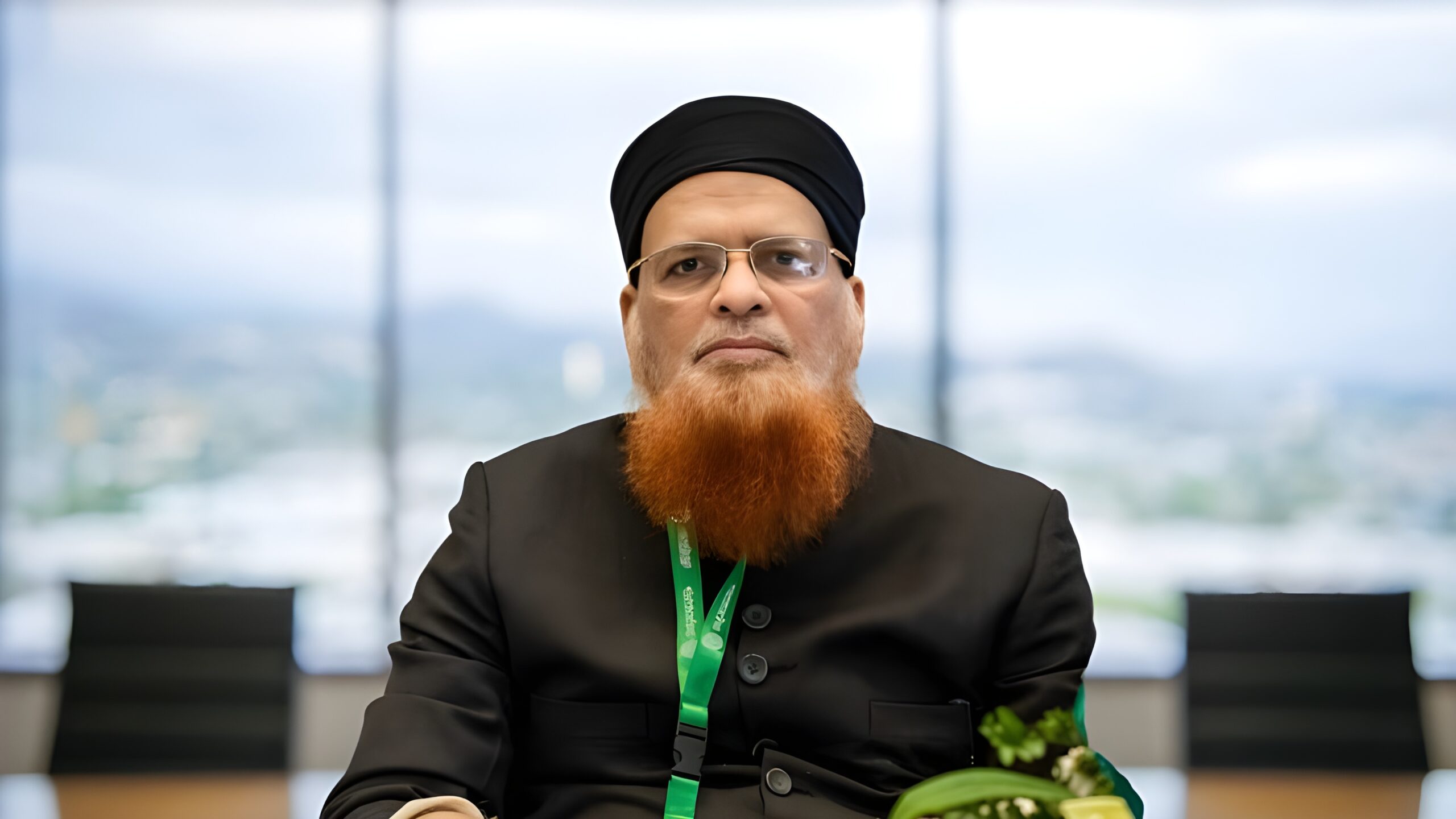
Justice Sheikh Mufti Muhammad Taqi Usmani is a leading global scholar of Hadith, Islamic jurisprudence (fiqh), and Islamic finance. He is widely considered the intellectual head of the Deobandi school of Islamic learning, while maintaining immense cross-jurisdictional authority outside of it. He served as a Judge on the Shariat Appellate Bench of the Supreme Court of Pakistan from 1982 to 2002.
Deobandi Intellectual Leadership & Seminary Administration: Usmani holds a central position as a figurehead within the modern Deobandi movement. Usmani was born in Deoband, India, and is the son of Mufti Muhammad Shafi (the former Grand Mufti of Pakistan), who founded Darul Uloom Karachi, a premier centre of Islamic education. He holds ijaza (authority) to teach hadith from Sheikh al-Hadith Mawlana Zakariya Khandelawi, and traversed the spiritual path of tasawwuf (Sufism) under the guidance of Sheikh Dr Abdul Hayy Arifi. In July 2026, Mufti Taqi Usmani was unanimously re-elected as the President of Wifaq-ul-Madaris Al-Arabia Pakistan for a second consecutive term. As Wifaq-ul-Madaris is the largest federation of Islamic seminaries (madaris) in Pakistan, his unopposed re-election solidifies his continued, undisputed control over the religious curriculum and seminary administration across the country.
Pioneer of Global Islamic Finance & Stance on Cryptocurrency: Usmani’s profound secondary influence stems from his status as a pioneer in Islamic banking. He has chaired or served on the Shariah boards of over a dozen global Islamic financial institutions. As a definitive authority on modern economic jurisprudence, in June 2026, the Darul Ifta at Jamia Darul Uloom Karachi issued a detailed fatwa signed by Mufti Taqi Usmani, ruling cryptocurrency trading, investment, and purchases impermissible (haram) under Islamic law. The fatwa outlined that cryptocurrencies like Bitcoin and USDT do not meet the criteria for maal (property or wealth) under Shariah, characterizing digital assets instead as the mere recording of fictitious or notional numbers in digital accounts.
Prolific Author and Translator: He has authored more than 143 books in Arabic, English, and Urdu. His bibliography includes a direct translation of the Qur’an into both English and Urdu, alongside a monumental six-volume Arabic commentary on Sahih Muslim. He serves as the Chief Editor of the monthly magazine Albalagh. His legal edicts (Fatawa Usmani), written over a span of 45 years, are preserved in multi-volume collections.
Masterful New Works: He continues to directly supervise The Hadith Encyclopaedia (Al-Mudawwanah Al-Jāmiʿah). This pioneering compilation assigns a universal reference number to each recorded hadith to make global citation as uniform as referring to a verse of the Qur’an. The expansive, multi-volume roadmap is projected to encompass over 300 volume-equivalents upon absolute completion, with the first major volumes already published and distributed. His recent groundbreaking text, The Jurisprudence (Fiqh) of Trade, culminates in a proposed statutory Code of Islamic Law for the Sale of Goods, serving as a template for international financial regulators.
State Honours: In 2019, the Sitara-i-Imtiaz (Star of Excellence) was conferred on Usmani by the President of Pakistan. This high civilian honour recognizes individuals who have rendered meritorious contributions to world peace, national security, or significant public and academic endeavours.
Stance on Regional Conflicts and Geopolitics: Mufti Usmani maintains a vocal position regarding Middle Eastern geopolitics. He has repeatedly affirmed the legal and moral right of the Palestinians to resist military occupation, actively calling upon Muslims globally to support relief efforts through structured financial donations and targeted corporate boycotts. Reflecting his broader vision for Islamic solidarity, in August 2026, Mufti Taqi Usmani publicly welcomed the landmark Mecca Joint Defence Agreement, the trilateral defence pact signed between Pakistan, Saudi Arabia, and Türkiye. He hailed the strategic agreement concluded near the Holy Kaaba as a monumental and necessary step toward fostering greater defense unity and collective strength across the Muslim world.